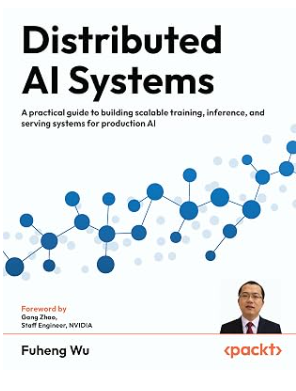
Distributed AI
Systems
A practical guide to building scalable training, inference, and serving systems for production AI — by Fuheng Wu, published by Packt.
#1 Best Seller & Top Rankings on Amazon
Ranked #1 across Parallel Programming, Memory Management, and AI Infrastructure categories.
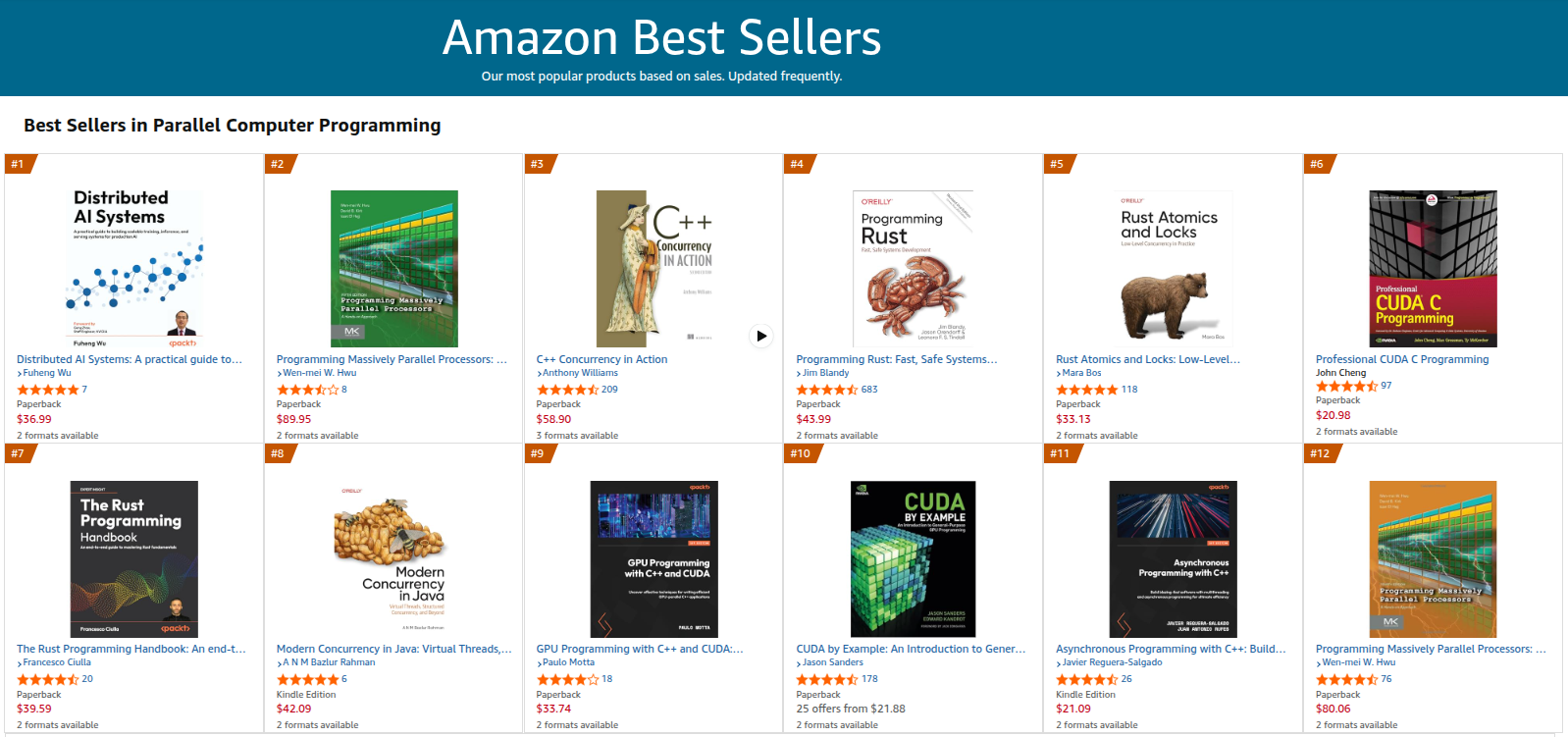
#1 Best Seller in Parallel Computer Programming
Parallel Computer Programming
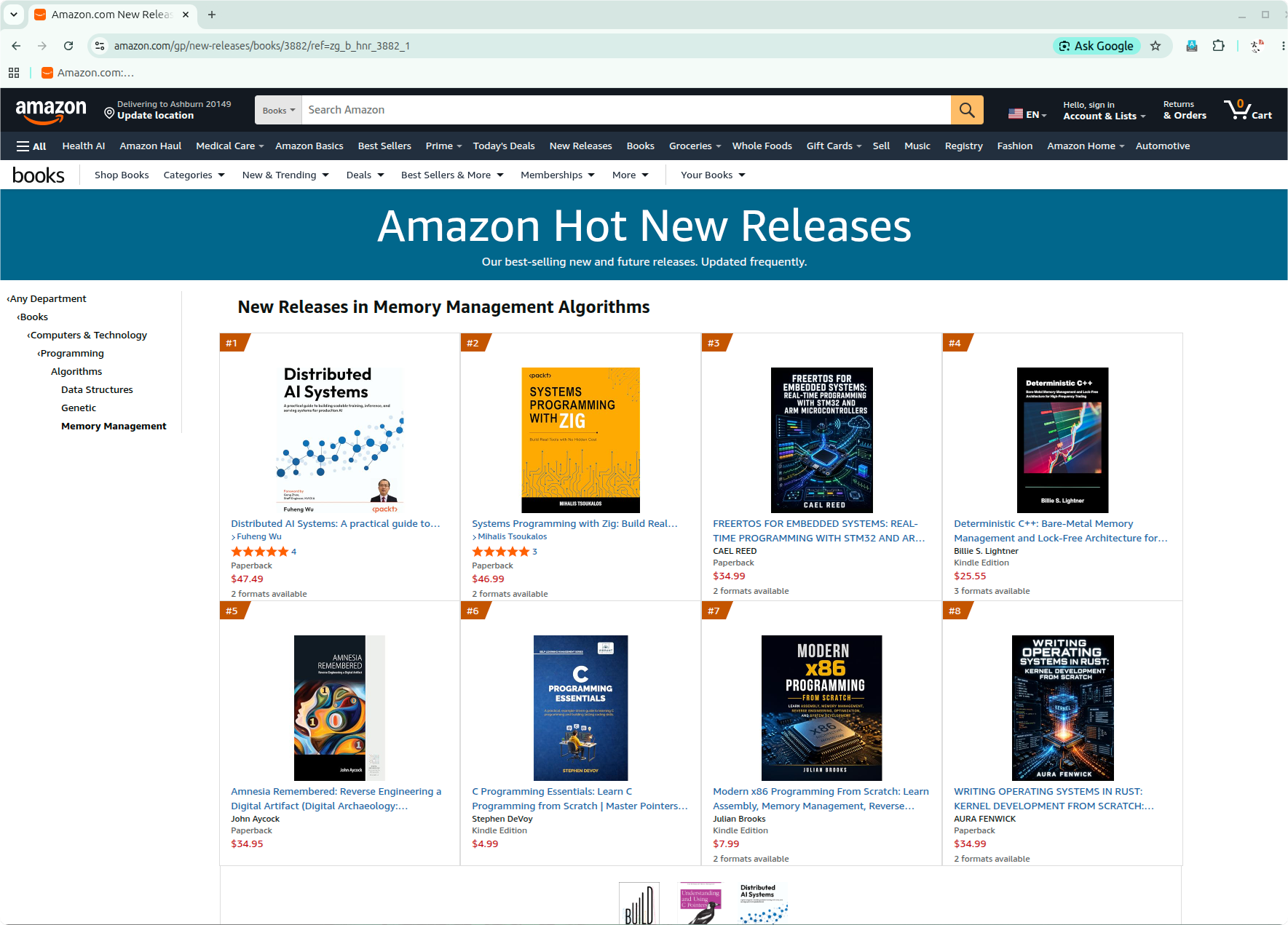
#1 Hot New Release in Computer Memory Management
Computer Memory Management
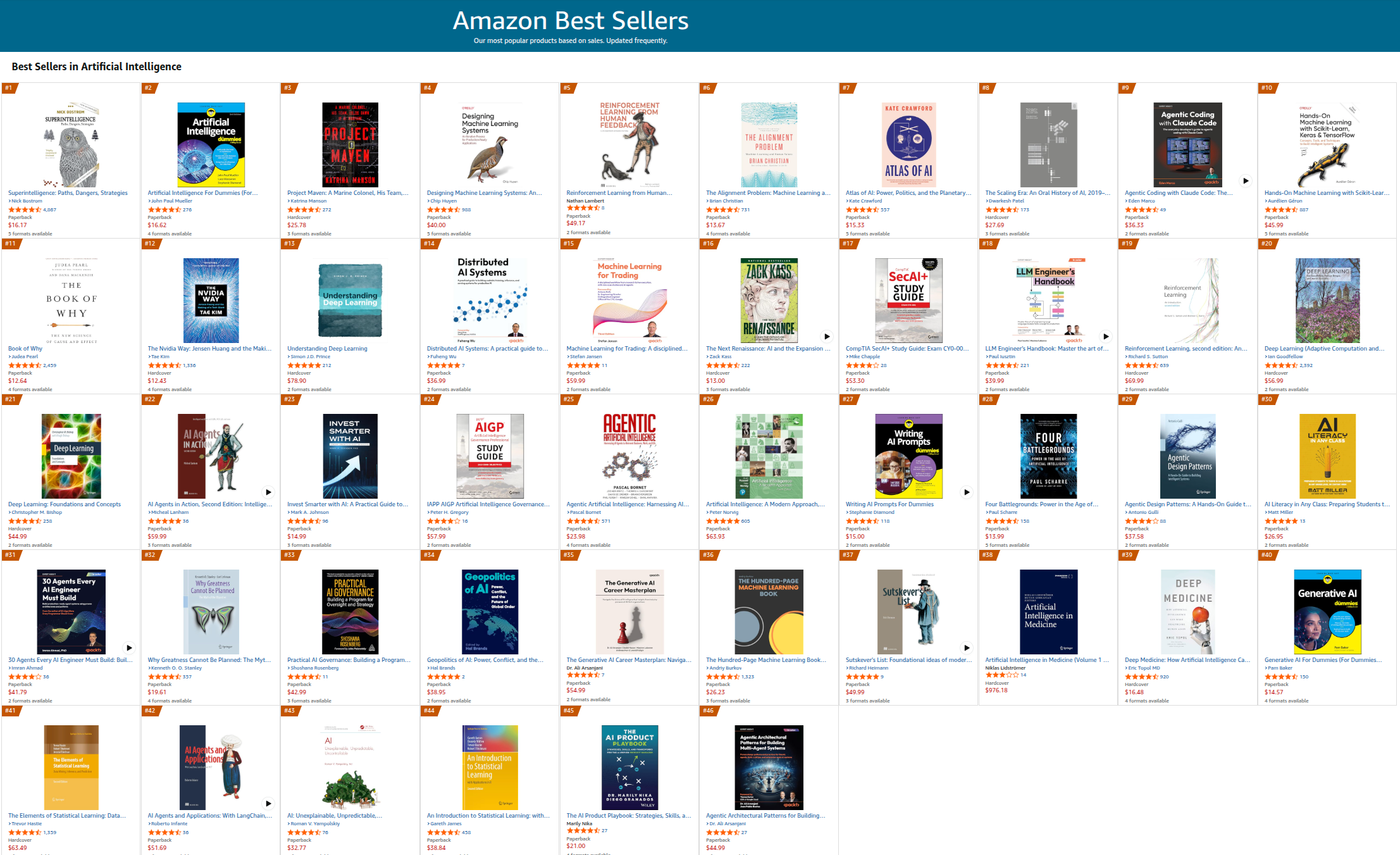
Top #14 Best Seller in Artificial Intelligence
AI & Machine Learning
One Path From Training to Production
Large AI models now reach billions or even trillions of parameters. Training and serving them is no longer a single-GPU exercise — it's a distributed systems problem.
Many resources explain one layer well: a training framework here, an inference engine there, a Kubernetes guide somewhere else. What's been missing is a single path from distributed training through inference to production serving, with runnable code you can execute on your own hardware. This book is that path.
The goal is not to memorize APIs, but to build intuition: why gradient synchronization hangs, when FSDP beats DDP, how PagedAttention changes serving economics, what to profile before you tune. Work through the examples chapter by chapter and you'll be able to scale workloads from a single GPU to a multi-node cluster, and deploy inference systems that are faster, more memory-efficient, and easier to operate. Frameworks will keep evolving; the systems patterns in this book are what endure.
Distributed Training
PyTorch DDP, FSDP, DeepSpeed ZeRO, and Megatron-style tensor, pipeline, and expert parallelism — and when to choose each.
Distributed Inference
PagedAttention, continuous batching, radix attention, and router-based serving with vLLM and SGLang.
Production Serving
Multi-node training on SLURM clusters, plus a complete Kubernetes serving stack with GPU scheduling and observability.
Benchmarking & Tuning
Systematic performance methodology, profiling tools, and what to measure before you optimize.
What This Book Covers
Eleven chapters, each with hands-on code, taking you from resource estimation to a production-grade serving stack.
Introduction to Modern Distributed AI
Resource estimation, data preparation, and your first distributed training example with PyTorch.
GPU Hardware, Networking, and Parallelism Strategies
GPU architecture, high-speed interconnects (NVLink/InfiniBand), and the parallelism strategies used throughout the book.
Distributed Training with PyTorch DDP
Data parallelism on single-node and multi-node clusters, including gradient bucket debugging and performance tuning.
Scaling with Fully Sharded Data Parallel (FSDP)
Parameter sharding, hybrid sharding, activation checkpointing, and mixed precision for memory-efficient training.
Beyond State Sharding with DeepSpeed and Megatron
DeepSpeed ZeRO stage 1-3 optimization and Megatron-style tensor, pipeline, and mixture-of-experts (MoE) parallelism.
Distributed Inference and vLLM
Inference fundamentals, PagedAttention, continuous batching, KV caching, and tensor/expert parallelism for serving.
Cross-Request Optimization with SGLang
Structured generation, radix attention cache sharing, and router-based serving optimizations across requests.
Running Distributed Training with SLURM
Launching, monitoring, and managing resilient multi-node training jobs on HPC SLURM clusters.
Production LLM Serving Stack
A complete serving stack with Kubernetes, GPU scheduling, dynamic routing, health checks, and observability.
Distributed Benchmarking and Performance Optimization
Benchmarking methodologies, PyTorch Profiler, Nsight Systems, and systematic bottleneck elimination.
The Evolving Landscape of Distributed AI
Emerging trends including ultra-large MoE architectures, edge–cloud coordination, and future systems directions.
What AI Engineers & Platform Leads Are Saying
Real feedback, verified Amazon purchases, and LinkedIn recommendations from engineers building distributed AI systems.

"Stop Training on a Single GPU and Hoping It Scales"
"Stop training AI on a single GPU and hoping it scales. This book teaches you to build distributed systems that go from one GPU to massive clusters + FREE code repo. Essential reading for anyone deploying production AI infrastructure."
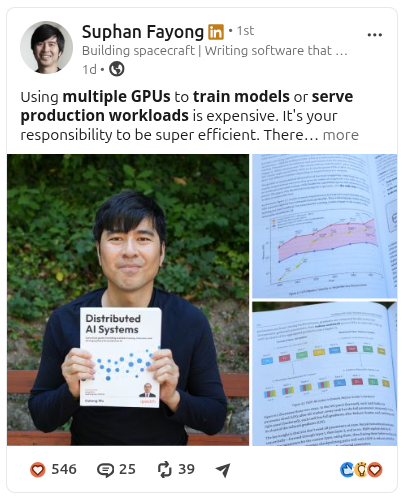
"Efficiency in Large-Scale GPU Training and Serving"
"Using multiple GPUs to train models or serve production workloads is expensive. It's your responsibility to be super efficient. There is a whole engineering layer to distributed AI that standard ML courses never touch. This book is a practical bridge between GPU hardware and distributed systems."
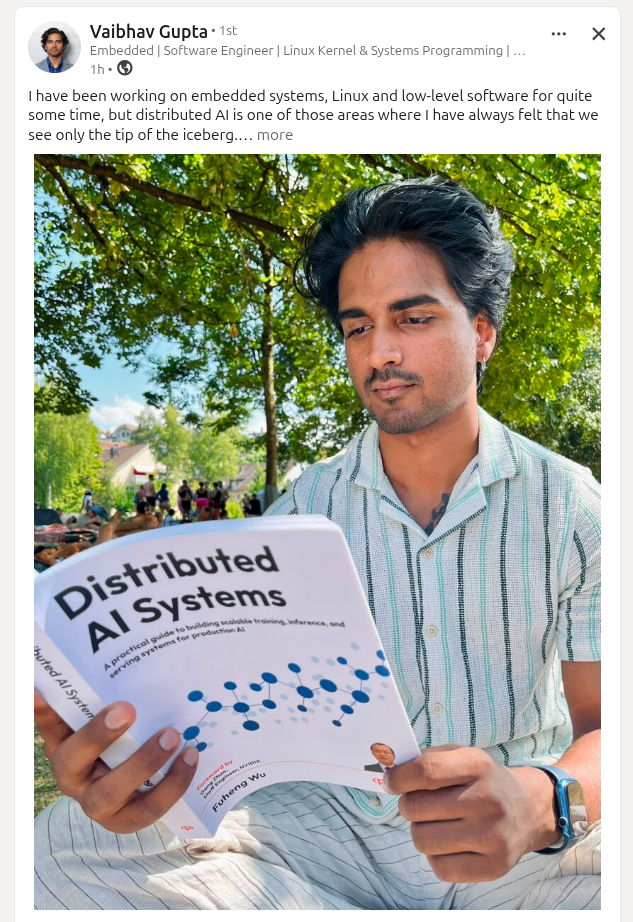
"Demystifying the Distributed AI Iceberg"
"I have been working on embedded systems, Linux and low-level software for quite some time, but distributed AI is one of those areas where I have always felt that we see only the tip of the iceberg. This book opens up the entire lifecycle of GPU hardware, interconnects, and scalable cluster orchestration."
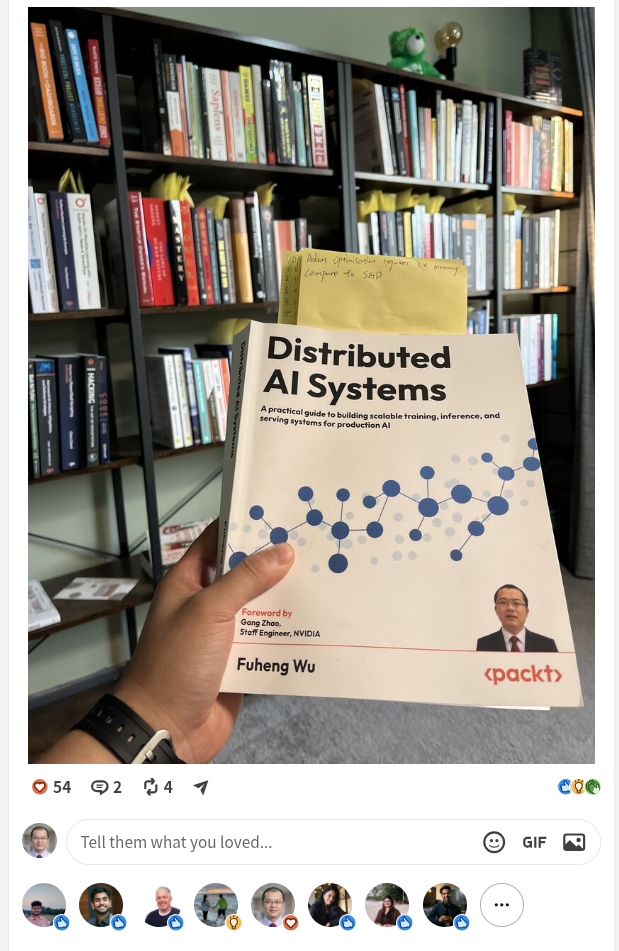
"A Brilliant Fusion of Theory and Large-Scale Practice"
"Large-scale training and serving of AI models is entirely different from local prototype development. This book combines deep systems theory with production practice with exceptional brilliance — the single most comprehensive blueprint for scalable AI."
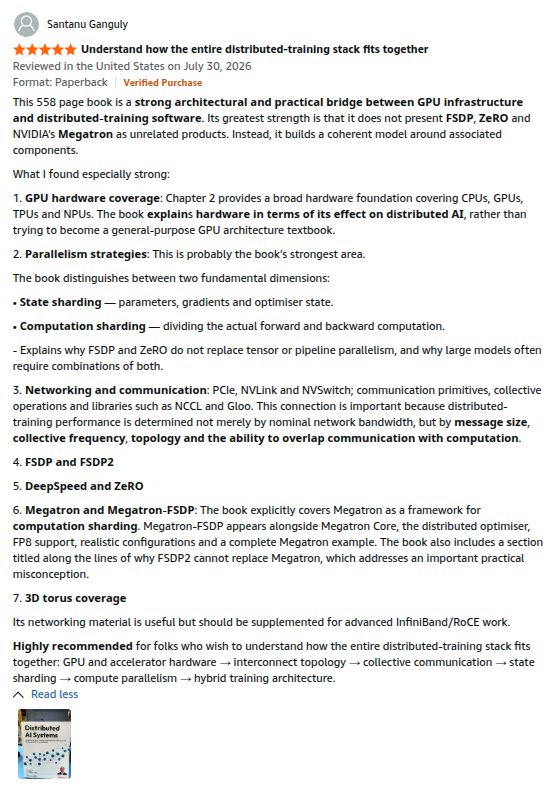
"Understand how the entire distributed-training stack fits together"
"This 558 page book is a strong architectural and practical bridge between GPU infrastructure and distributed-training software. Its greatest strength is that it does not present FSDP, ZeRO and NVIDIA's Megatron as unrelated products. Instead, it builds a coherent model around associated components: state sharding, computation sharding, networking primitives (NCCL, NVLink), and Megatron-FSDP."
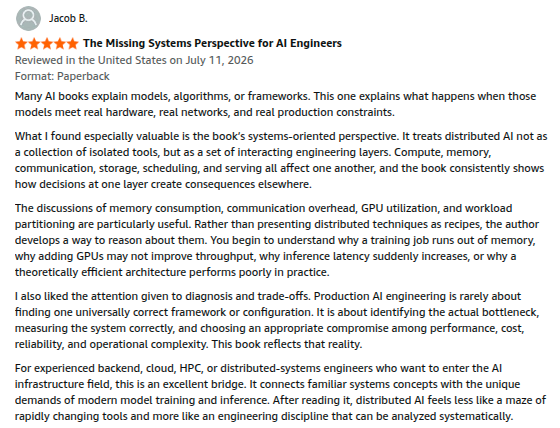
"The Missing Systems Perspective for AI Engineers"
"Many AI books explain models, algorithms, or frameworks. This one explains what happens when those models meet real hardware, real networks, and real production constraints. Compute, memory, communication, storage, scheduling, and serving all affect one another. For backend, cloud, or HPC engineers wanting to enter AI infrastructure, this is an excellent bridge."
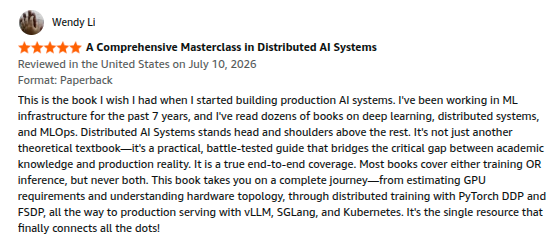
"A Comprehensive Masterclass in Distributed AI Systems"
"This is the book I wish I had when I started building production AI systems. Most books cover either training OR inference, but never both. This book takes you on a complete journey—from estimating GPU requirements and hardware topology, through distributed training with PyTorch DDP/FSDP, all the way to production serving with vLLM, SGLang, and Kubernetes."
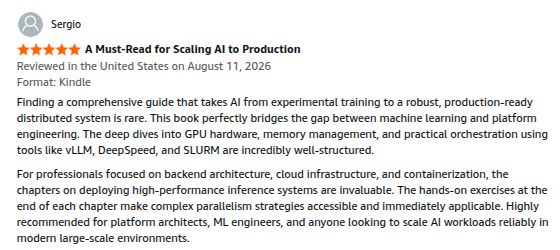
"A Must-Read for Scaling AI to Production"
"Finding a comprehensive guide that takes AI from experimental training to a robust, production-ready distributed system is rare. This book perfectly bridges the gap between machine learning and platform engineering. The deep dives into GPU hardware, memory management, and practical orchestration using tools like vLLM, DeepSpeed, and SLURM are incredibly well-structured."
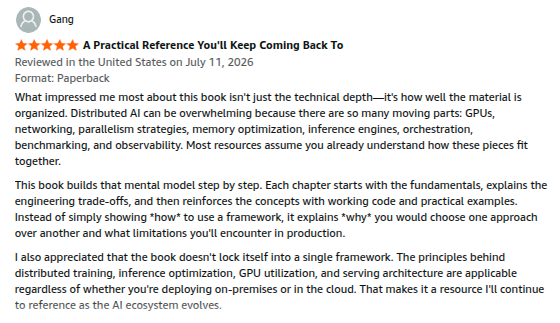
"A Practical Reference You'll Keep Coming Back To"
"What impressed me most about this book isn't just the technical depth—it's how well the material is organized. Distributed AI can be overwhelming because there are so many moving parts. This book builds that mental model step by step with working code and practical examples, explaining why you would choose one approach over another."
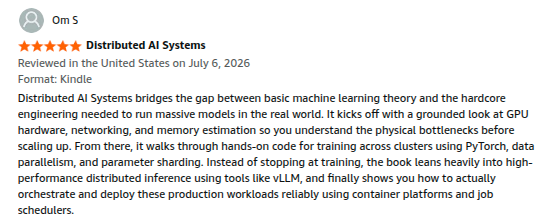
"Bridges Machine Learning Theory and Hardcore Engineering"
"Distributed AI Systems bridges the gap between basic machine learning theory and the hardcore engineering needed to run massive models in the real world. It kicks off with a grounded look at GPU hardware, networking, and memory estimation so you understand the physical bottlenecks before scaling up."
Every Chapter Runs
Clone the official example code repository and work through each chapter's exercises in order — early chapters establish hardware and parallelism concepts that later chapters build on.
- ✓ Runnable on a single GPU, scales to multi-node clusters
- ✓ No local GPU? Use cloud notebooks (e.g. Kaggle) for early chapters
- ✓ SLURM or local Kubernetes for cluster-focused chapters
- ✓ Companion MockSphere questions & mind maps in Member Portal
# Clone the official example code
$ git clone https://github.com/PacktPublishing/Distributed-AI-Systems
$ cd Distributed-AI-Systems

[SUCCESS] 11 chapters of runnable, hands-on examples.
[INFO] Start with Chapter 1 — resource estimation & first PyTorch job.
[INFO] Later chapters: multi-node training, vLLM/SGLang serving, K8s.

Prerequisites: Python + PyTorch, Linux, one NVIDIA GPU (min).
# Latest code always kept in sync with the book on GitHub.From the Foreword
"Distributed AI Systems is the comprehensive blueprint the industry has desperately needed — and the book I wish Fuheng had written years ago. He has demystified the black box of infrastructure engineering for AI, treating training, inference, and cluster management not as isolated domains, but as an integrated lifecycle."
Fuheng Wu

Get in Touch & Stay Connected
Feedback from readers is always welcome.
General Feedback
Questions about the book? Email customercare@packtpub.com.
Errata & Corrections
Found a mistake? Report it at packtpub.com/support/errata.
Ask the Author Directly
Have a deep systems question? Leave a message in the Members Portal.
Ready to Build Production-Grade AI Systems?
Free with your book: DRM-free companion resources, high-res diagrams, and MockSphere interview questions.